Blogs
Bellboy vs Doorman vs Valet: What's the Real Difference?


Blogs
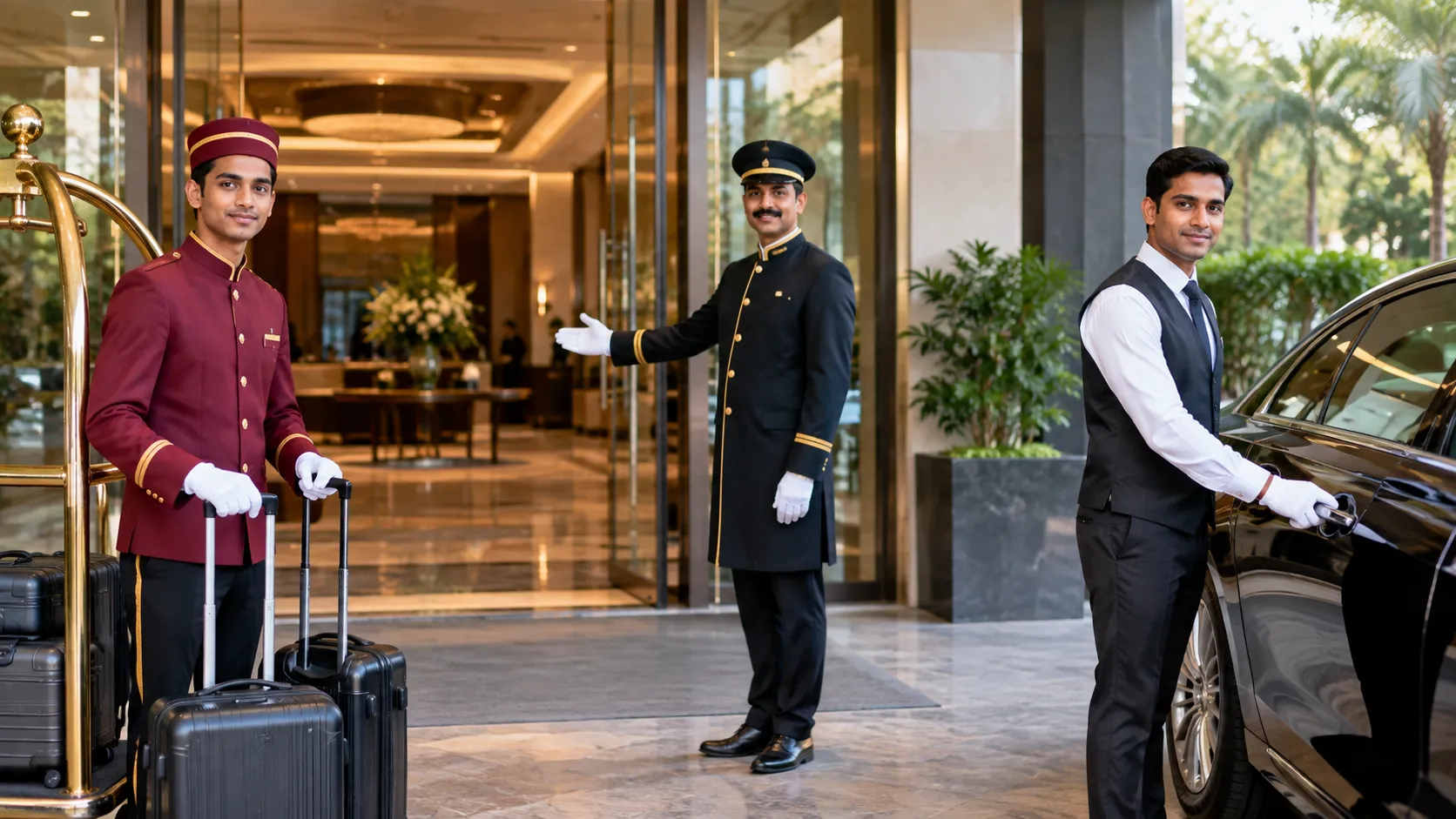
Ever noticed how "bellboy," "doorman," and "valet" get thrown around like they're the same job? A lot of blogs and job listings use them interchangeably. They're not the same, though — each one stands at a different spot near the hotel entrance, does a different job, and meets the guest at a different moment.
We put this guide together based on the front office training our students actually go through at Sri Maniya Institute of Hotel Management, where these guest-service roles are taught as separate, specific skills — not one blurry job description.
Here's the quick version:
Bellboy — carries your luggage and walks you to your room
Doorman — greets you at the entrance and sorts out your transport
Valet — parks and retrieves your car
Now let's break each one down properly, and then line them up side by side.
Think of the bellboy (also called a bellhop or bellman) as the person who takes over the moment you walk in with your bags. They handle your luggage from the lobby all the way to your room — and back again when you check out.
On a typical day, a bellboy will:
Carry luggage safely to and from guest rooms
Walk guests to their rooms and point out the room features
Share quick local tips — nearby restaurants, directions, must-see spots
Jump in and support the front desk when check-in or check-out gets busy
This is exactly where the bellboy vs doorman mix-up starts. In smaller hotels, one person often does both jobs. But once a hotel is fully staffed, these become two clearly separate roles.
The doorman is usually the very first face a guest sees — literally standing at the entrance, ready to welcome people in. Their whole job revolves around that door and everything happening around it.
A doorman typically:
Opens the entrance door and greets arriving guests
Hails taxis or coordinates airport transfers
Points guests toward the check-in desk or the waiting bellboy
Keeps a visible, alert presence at the entrance
Here's the key difference from a bellboy: a doorman almost never touches the luggage. Their focus stays at the door, not on the journey to the room.
A valet — specifically, a valet parking attendant — takes care of exactly one thing well: your car. They work right alongside the doorman during busy arrival and departure windows.
A valet's job comes down to:
Parking guest vehicles quickly and carefully
Bringing the car back the moment it's requested
Coordinating with the doorman so arrivals don't back up
Handling every vehicle with zero damage, every time
The bellboy vs valet comparison is actually the easiest one to remember — a bellboy's world is luggage and rooms, a valet's world starts and ends with the vehicle.
|
Role |
Primary Duty |
Where They're Positioned |
Main Guest Interaction |
|
Bellboy |
Carries luggage, escorts guests to rooms |
Lobby to guest room |
From arrival through room check-in |
|
Doorman |
Greets guests, manages entrance traffic |
Main entrance |
First and last point of contact |
|
Valet |
Parks and retrieves vehicles |
Entrance/parking area |
Vehicle handover and return |
Pretty often, yes. Walk into a smaller hotel or guesthouse, and you'll likely find one person greeting you, carrying your bag, and maybe even parking your car — simply because there aren't enough staff to split the work. Bigger hotels and resorts, on the other hand, keep these as three distinct, specialised roles, each reporting up to the bell captain or front office manager.
Honestly, this comes down to the hotel and its tipping culture more than the job title itself. Valets tend to pick up a solid chunk of income through tips tied directly to how well they handle a car. Bellboy and doorman pay, on the other hand, usually tracks more with the hotel's star category and how many guests pass through. Rather than chasing rough numbers, it helps to know this: all three roles sit under front office operations, and growing in any of them usually leads toward a bell captain or front office supervisor role.
These jobs might look simple from the outside, but each one leans hard on communication, grooming, quick thinking, and genuine guest-handling skill — which is exactly what a structured Front Office training program builds. At Sri Maniya, students train across both front office and room division operations, so they walk in ready for guest-facing work in general, not boxed into just one job title.
That's also why trained candidates tend to grow faster than someone starting from scratch. They've already absorbed the guest-service standards that untrained staff usually pick up slowly, mistake by mistake, on the job.
Here's the good news — you don't have to pick just one this early. Front office training builds skills that carry across bellboy, doorman, and valet work, and most hotels genuinely appreciate a well-groomed, communication-ready candidate who can move between roles. If you're thinking long-term, though, the bellboy path has the clearest career ladder on paper — bell captain, then front office supervisor, then eventually front office manager.
Curious how this training actually works day to day? Explore our Front Office training as part of the hotel management course at Sri Maniya.
FAQ
Is a bellboy the same as a doorman?
No. A bellboy carries luggage and walks guests to their rooms, while a doorman greets guests at the entrance and handles transport and security at the door. Smaller hotels sometimes combine both into one role, but larger properties keep them separate.
What does a valet do in a hotel?
A valet parks and retrieves guest vehicles, usually working right alongside the doorman during busy arrivals and departures. Unlike a bellboy or doorman, a valet's job is entirely about the vehicle.
Which front office job pays more — bellboy or valet?
It depends more on the hotel and its tipping culture than the job title. Valets often earn a good share of income through car-related tips, while bellboy and doorman pay tends to follow the hotel's category and guest volume.
Do all hotels have separate bellboys, doormen, and valet staff?
Not always. Smaller hotels and guesthouses often merge these duties into one role because of limited staff, while larger hotels and resorts keep them as separate, specialised positions.