Blogs
Diploma in Food Production: The Fastest Path to Becoming a Chef in India

Blogs
If cooking is what actually excites you — not front office, not housekeeping, just the kitchen — you've probably asked yourself this: do you really need a full 3-year degree to become a chef, or is there a quicker way in?
There is. It's called a Diploma in Food Production, and it's built for exactly this situation.
A Diploma in Food Production is a 1-year, kitchen-focused course
It gets you into a professional kitchen faster than a 3-year degree
It's the right fit if your goal is hands-on cooking, not broader hotel management
Let's go through what it actually involves, and how it stacks up against the longer route.
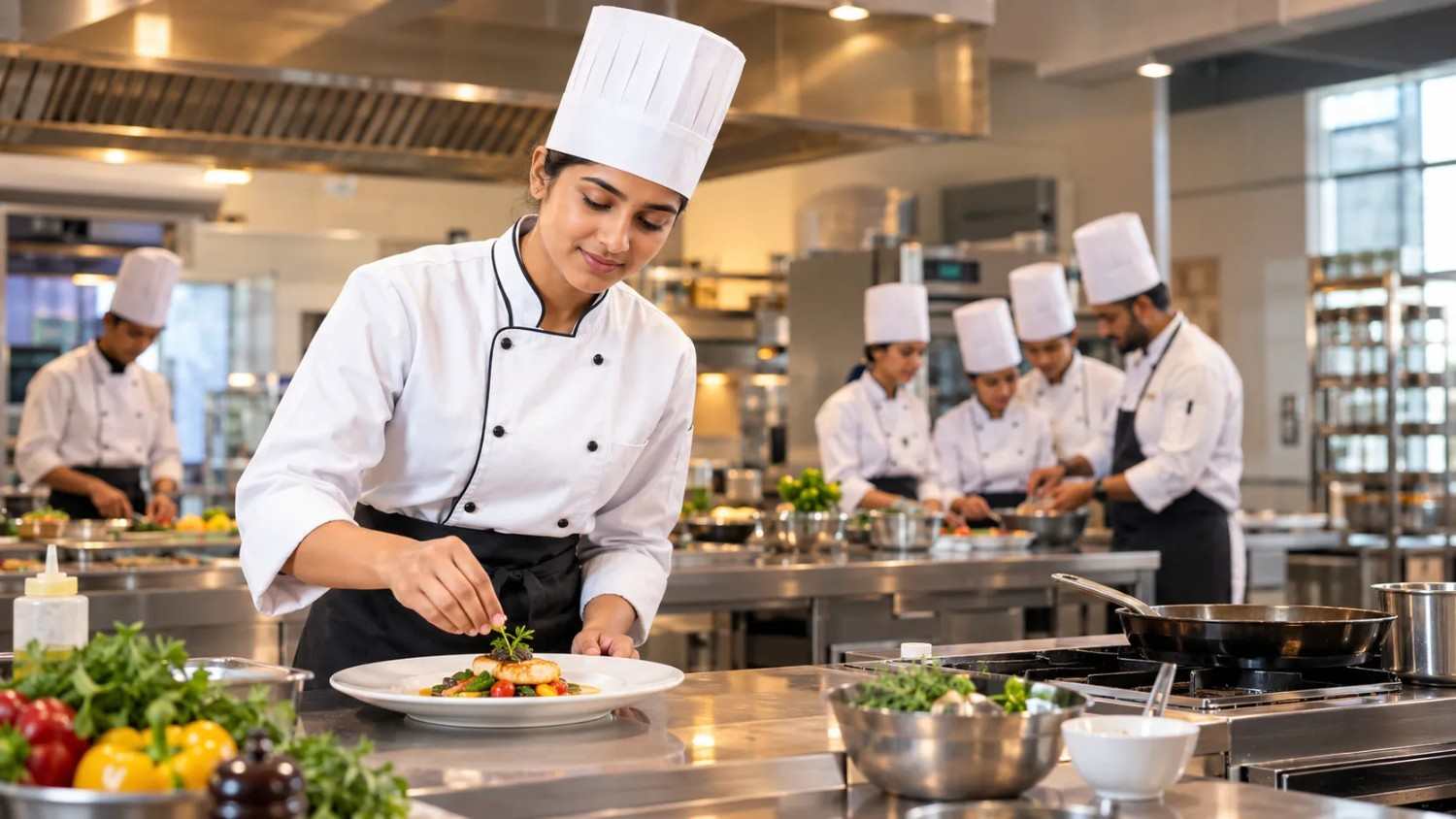
It's a short, focused course built entirely around the kitchen — culinary techniques, cooking methods, food safety, and hands-on practical training. Where a hotel management degree spreads your time across front office, housekeeping, and food & beverage service, a Diploma in Food Production puts almost all of that time into one place: learning to cook properly, under real kitchen conditions.
Think of it as narrow and fast versus broad and longer. A 3-year B.Sc. in Catering and Hotel Administration trains you across the entire hospitality operation — kitchen included, but also front office, housekeeping, and management skills, because it's preparing you for hotel leadership roles eventually. A Diploma in Food Production skips the broader hospitality training and goes straight for kitchen skills, in a fraction of the time.
Neither one is "better" on its own — it depends entirely on what you actually want to do.
Core culinary techniques across cuisines
Kitchen operations and workflow
Food safety and hygiene standards
Practical, hands-on cooking training in real kitchen setups
It's deliberately concentrated. You're not spending weeks on subjects unrelated to cooking — every part of the course points toward one outcome: being kitchen-ready.
Two things stack together here. First, the course itself is just one year, compared to three. Second, at institutes that build internship exposure into training from the start, you're getting real kitchen experience while degree students are still finishing classroom semesters. At Sri Maniya, Internship from Day One is a core part of how every program runs — students start gaining practical, real-world experience early, not after graduation.
Put those two together, and you're realistically looking at a working kitchen job well before someone on the 3-year track even reaches their internship year.
It's a fair question — you can technically walk into a kitchen as an untrained helper with no course at all, and some people do start that way. In terms of pure entry speed, it's about the same as joining after a 1-year diploma, sometimes even faster, since there's no course to complete first.
But the speed of entry isn't the same as the speed of growth. Untrained entry usually means learning everything on the job, station by station, with no structured base to build on — which tends to slow down how quickly you move beyond basic prep work. A Diploma in Food Production gets you into the kitchen at a similar stage, but with the techniques, food safety knowledge, and hands-on training already in place, so the climb afterward is noticeably shorter. If your goal is genuinely the fastest path to becoming a chef — not just the fastest way into a kitchen — the diploma route usually wins once you look past day one.
Here's the honest part. A diploma gets you into the professional kitchen system — typically at an entry-level, commis-equivalent position, learning stations and building speed under supervision. That's true no matter which course path got you there; every chef, diploma or degree, starts at the bottom of the kitchen and works up through experience.
What the diploma does is get you there faster. What happens after that — how quickly you move up — depends on the same things it always does: consistency, skill, and time in the kitchen.
This path makes the most sense if:
You already know cooking is what you want to do, not hospitality management broadly
You want to start earning and gaining kitchen experience sooner rather than later
You'd rather test the field with a shorter commitment before deciding on anything longer
If you're still weighing this against a full degree, our Diploma vs B.Sc comparison guide breaks down the decision in more detail.
Yes — and this is where a structured institute path helps. Sri Maniya offers an Integrated Diploma in Catering and Hotel Administration + B.Sc. program, so if you start with the shorter diploma and later decide you want the fuller degree and broader hospitality management skills, you don't have to start over from scratch.
Neither path is the "correct" one in general — it comes down to how fast you want to be standing in a working kitchen versus how broad you want your hospitality skill set to be. If cooking is the goal and speed matters, the Diploma in Food Production is built exactly for that.
Want to know more about how the course actually runs? Explore our Diploma in Food Production or speak with our admissions team about which path fits your goal.
FAQ
Frequently Asked Questions
Is a diploma enough to become a chef?
Yes. A Diploma in Food Production gets you into an entry-level kitchen role faster than a degree. Growing into senior chef roles after that still depends on experience.
Is a diploma faster than skipping training and joining a kitchen directly?
Entry speed is about the same either way. The difference shows up later — diploma-trained candidates usually progress faster since they already know culinary techniques and food safety, instead of learning everything on the job.
How long does it take to become a chef in India?
About 1 year with a Diploma in Food Production, or 3 years with a B.Sc. in Catering and Hotel Administration. Reaching senior chef roles after either path depends on kitchen experience, not the course itself.
What is the difference between a food production diploma and a hotel management degree?
A food production diploma focuses entirely on kitchen and culinary skills over 1 year. A hotel management degree covers the kitchen along with front office, housekeeping, and hospitality management over 3 years, preparing students for broader hotel leadership roles.
Can I upgrade from a diploma to a degree later?
Yes. Sri Maniya's Integrated Diploma + B.Sc. program allows students to continue from the diploma into the full degree without restarting their education.